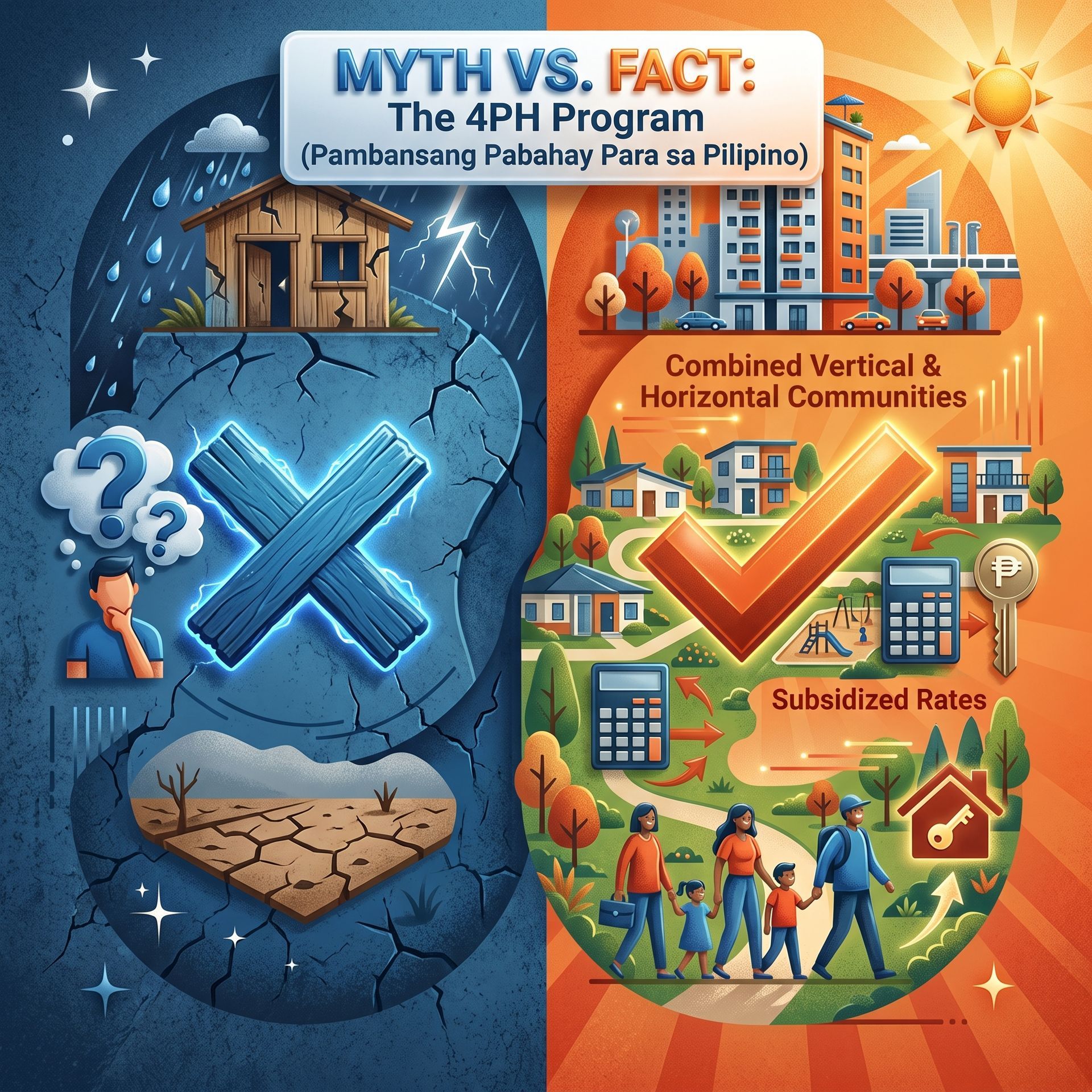
MYTH VS. FACT: The 4PH Program (Pambansang Pabahay Para sa Pilipino)
Jerwin Munoz | August 22, 2026
Finding an affordable path to homeownership in the Philippines can feel like an uphill battle. With skyrocketing land values, high condo price tags, and strict commercial bank lending standards, millions of Filipino families find themselves trapped in endless rental cycles.
Enter the 4PH Program—short for Pambansang Pabahay Para sa Pilipino—the flagship housing initiative of the Department of Human Settlements and Urban Development (DHSUD).
Despite being heavily covered in national news, significant misinformation surrounds the program. Is it a free government dole-out? Is it strictly reserved for informal settlers? Can middle-income earners and first-time buyer investors participate?
In this comprehensive guide, we separate myth from fact to help you understand how the 4PH program works, who it’s actually for, and how you can take advantage of it through Pag-IBIG Fund.
What is the 4PH Program? An Overview
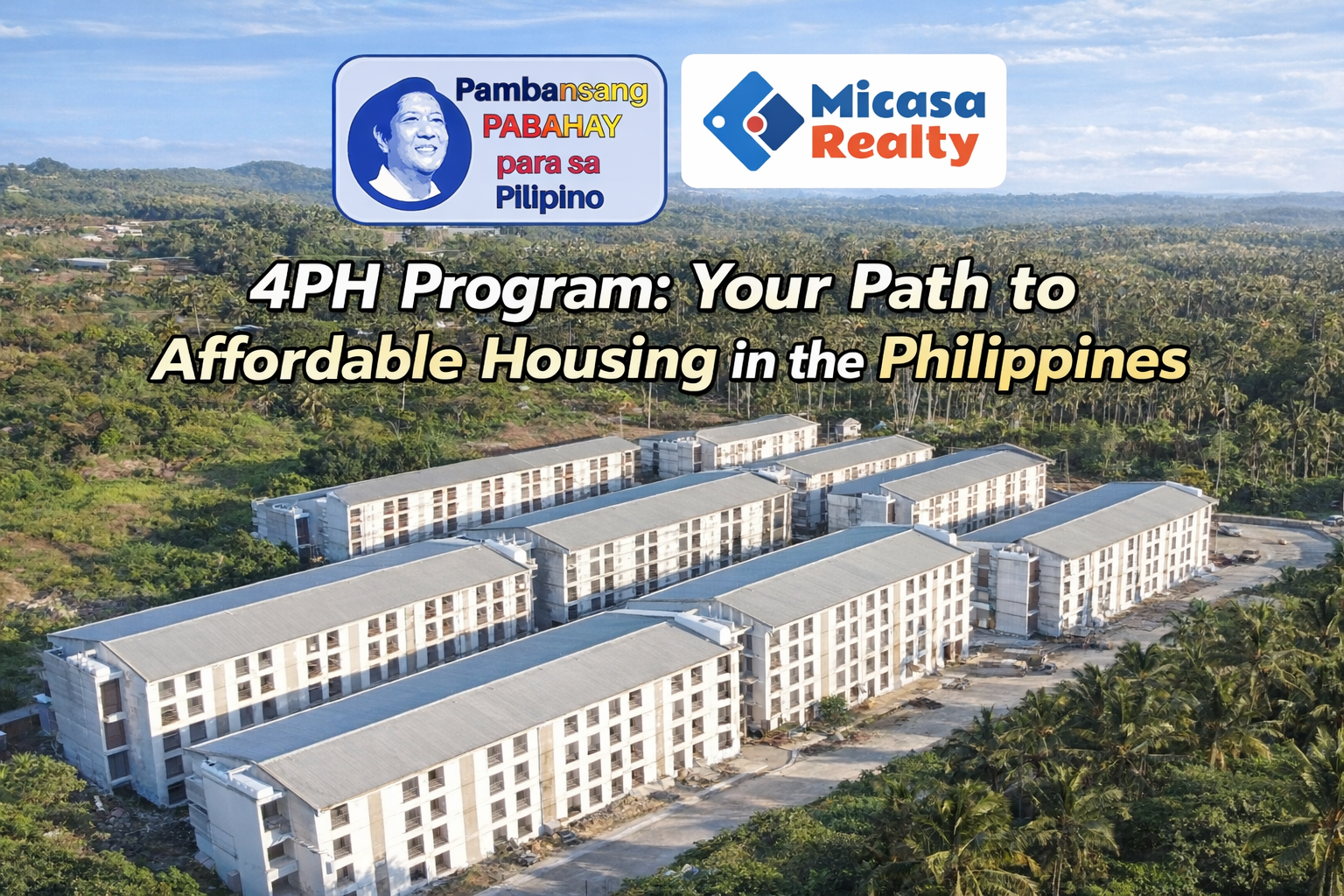
Launched under Executive Order No. 34, the Pambansang Pabahay Para sa Pilipino (4PH) Program is a national shelter strategy designed to address the country's massive housing backlog.
Unlike traditional government socialized housing projects of past decades—which often built horizontal housing tracts in remote areas lacking basic services—4PH focuses on
high-density, in-city vertical communities (condominiums and mid-rise buildings). These developments are strategically built near employment hubs, public transit, and commercial centers so beneficiaries don't have to sacrifice their livelihoods or daily commutes.
4PH Program: Key Myths vs. Facts
Myth 1: "4PH is only for the poorest of the poor or informal settlers."
FACT: While informal settler families (ISFs) and low-income households are priority beneficiaries, the 4PH program is fully open to minimum-wage earners, middle-income employees, government workers, and OFWs.
One of the most persistent misconceptions is that 4PH is strictly a social welfare relocation program. DHSUD leadership and Pag-IBIG representatives have clarified that having a stable source of income is mandatory to qualify. Because 4PH relies on end-user loan financing through institutions like Pag-IBIG Fund, formal workers earning regular salaries are ideal candidates.
If you are a middle-income earner, a young professional buying your first home, or an OFW wanting an affordable real estate investment back in the Philippines, you qualify for 4PH as long as you meet Pag-IBIG membership requirements.
Myth 2: "The government is giving away free homes under 4PH."
FACT:
4PH is
not a free dole-out or a 4Ps extension. It is a subsidized, loan-based homeownership program.
Do not confuse 4PH with 4Ps (Pantawid Pamilyang Pilipino Program). 4PH is a structured housing loan program. Beneficiaries pay monthly amortizations over a long-term period (up to 30 years) via Pag-IBIG or participating banks.
The government’s primary financial support comes in two forms:
- Interest Subsidies: DHSUD provides up to a 5% interest subsidy for eligible buyers, lowering monthly amortizations significantly compared to market-rate bank loans.
- Reduced Unit Prices: Because Local Government Units (LGUs) often partner to provide land and private contractors build at controlled scales, 4PH condo units are priced below private market rates.
Myth 3: "4PH units are located far away from city centers."
FACT:
4PH prioritizes
in-city and near-city vertical developments.
Old government housing projects were infamous for relocating families to remote provinces with zero job opportunities, poor water access, and no transportation options. 4PH deliberately abandons this model.
By building 4-story to 20-story vertical developments in urban centers (Metro Manila, Cavite, Laguna, Cebu, Davao, and key provincial cities), 4PH keeps homeowners connected to:
- Workplaces and business districts.
- Public transportation corridors.
- Schools, hospitals, and public markets.
Myth 4: "You get bare lots or sub-standard structures."
FACT:
Units are delivered as
finished, modern condo apartments inside master-planned communities.
4PH projects are designed as fully integrated townships. Beyond your individual apartment unit, 4PH communities incorporate basic public amenities such as commercial spaces, health centers, daycare facilities, and green open spaces. Construction is executed in partnership with accredited private developers adhering to National Building Code standards.
4PH vs. Traditional Pag-IBIG Housing vs. Private Condos
To see where 4PH fits into the Philippine real estate market, consider this comparison table:
| Feature | 4PH Program Units | Standard Pag-IBIG Housing | Private Developer Condos |
|---|---|---|---|
| Primary Target | Low-to-Middle Income Earners & ISFs | Any Pag-IBIG Member | Middle-to-High Income Earners |
| Property Type | Vertical Condos / Townships | Subdivisions / Townhouses | Mid-to-High Rise Condos |
| Location Focus | In-City / Near-City Urban | Suburbs / Outlying Provinces | Prime City Business Districts |
| Government Subsidy | Up to 5% Interest Subsidy | Standard Pag-IBIG Rates | None |
| Estimated Monthly | Starts as low as ₱3,500 – ₱6,000+ | Starts ₱6,000 – ₱15,000+ | Starts ₱15,000 – ₱40,000+ |
Who is Eligible for the 4PH Program?
According to guidelines from the DHSUD and Pag-IBIG Fund, you can apply for a 4PH unit if you meet these baseline requirements:
- Pag-IBIG Fund Member: You must be an active Pag-IBIG member with at least 24 months of total contributions. (Note: If you have fewer than 24 months, you can make a lump-sum payment to complete the requirement instantly).
- Proof of Income:
You must have a verified income source (e.g., Certificate of Employment, payslips, ITR, business permit, or OFW contract).
- No Prior Defaulted Housing Loan:
You must not have an existing defaulted housing loan with Pag-IBIG Fund or other financial institutions.
- First-Time Homeowner Priority: You should not currently own a residential property funded by a prior government housing program.
Essential Requirements & Documents
When applying for a 4PH unit, prepare these documents in advance to speed up pre-validation:
- Government-Issued IDs: 2 valid IDs with signatures (Driver’s License, Passport, UMID, National ID, etc.).
- Proof of Income:
- For Employed: Latest 3 months' payslips & Certificate of Employment and Compensation (CEC).
- For Self-Employed: Income Tax Return (ITR), Audited Financial Statements, and Business Permit.
- For OFWs: Valid Overseas Employment Certificate (OEC), employment contract, and proof of remittance.
- Pag-IBIG Member’s Data Form (MDF): Updated with active contribution status.
- Micasa Realty Pre-Registration Form
Step-by-Step Application Guide for 4PH
Step 1 — Verify Your Pag-IBIG Status: Log in to your Virtual Pag-IBIG account or visit a Pag-IBIG branch to confirm you have 24 monthly contributions.
Step 2 — Inquire via Micasa Realty: Learn more about 4PH projects across the Philippines to check current available inventories and location
Step 3 — Submit Eligibility Documents: Provide proof of income and identity for initial screening.
Step 4 — Pag-IBIG Pre-Validation: Pag-IBIG reviews your financial capacity to determine loan coverage and exact monthly amortization based on interest subsidies.
Step 5 —
Unit Allocation & Turn Over: Once approved, you sign your loan documents and prepare for turn-over upon project completion.
Why 4PH is a Game-Changer for First-Time Buyer Investors
If you are a young professional, minimum wage worker, or middle-income employee, 4PH provides an unparalleled entry point into property ownership:
- Equity Building vs. Renting:
Instead of spending ₱5,000 to ₱10,000 monthly on a rental unit with zero return, your 4PH payments build real long-term property equity.
- Interest Protection: The 5% government interest rate subsidy shields buyers from high commercial interest rates.
- Prime Location Value:
In-city locations naturally appreciate faster than rural land, giving first-time buyers an asset that grows in value over time.
Frequently Asked Questions (FAQ)
Can OFWs apply for a 4PH condo unit?
Yes. OFWs are considered priority formal earners. As long as you maintain active Pag-IBIG membership and present an employment contract or proof of remittance, you can appoint a Special Power of Attorney (SPA) in the Philippines to manage your application.
Is there an age limit for 4PH applicants?
The age limit aligns with standard Pag-IBIG housing loan policies. Applicants must not exceed 65 years old at the time of application and must not be older than 70 years old at loan maturity.
Can I rent out my 4PH unit?
4PH is primarily designed for owner-occupancy to solve the national housing shortage. However, specific guidelines regarding lease arrangements after loan maturity or through formal rental management frameworks are set by DHSUD and your local housing authority.
Final Thoughts: Don't Let Misinformation Hold You Back
The 4PH Program represents a significant shift in Philippine public housing. It is not a welfare dole-out, nor is it exclusive to informal settlements. It is an accessible, subsidized, and secure path for middle-income workers, minimum-wage earners, and first-time buyers to build equity in modern vertical communities.
If you're ready to stop renting and start owning, check your Pag-IBIG contribution status today and reach out to your local government unit or real estate professional to explore active 4PH developments near you!
Recent Posts


Promos/Discounts






LOOKING FOR A PROPERTY?